
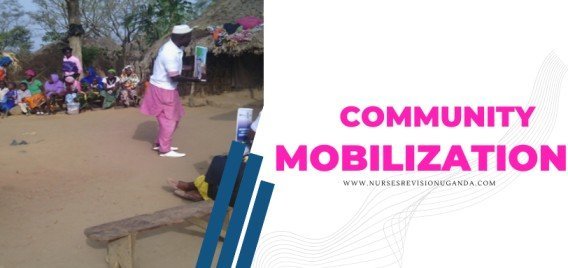
Community Mobilization & Sensitization
On this page
THE COMMUNITY HEALTH CHRONICLES: EPISODE 6
In Episode 5, Student Nurse Amina diagnosed the primary health threat in Kiyunga Village: frequent waterborne diseases caused by an unprotected water spring. She has her data, her diagnosis, and a brilliant action plan on paper. But as she looks at the spring, she realizes she cannot dig trenches, lay pipes, and build a protective wall by herself! She needs the village's help.
To turn her plan into reality, Amina must inform the people, spark their interest, and rally them to take action for their own health. Welcome to Episode 6: Community Mobilization & Sensitization. Let's see how Amina wakes up the village and gets everyone moving!
I. Definition of Terms
This phase immediately follows Community Diagnosis.
- Community Mobilization is the process of bringing together individuals, groups, and organizations within a community with a common purpose to collectively identify and address issues and challenges that affect their well-being. It aims to plan, implement, and evaluate activities in a participatory and sustained manner.
- Sensitization is a way of informing people or creating awareness of what is happening, why it is happening, and what is required of them.
II. Importance of Effective Community Mobilization & Sensitization
Mobilization is the engine that drives community health programs forward. Its benefits and positive impacts include:
A. Core Benefits
- Encourages local ownership: Empowers community members to take ownership of initiatives and solutions, leading to a sense of pride, responsibility, and accountability for the outcomes.
- Promotes sustainability of health programs: When communities actively participate in planning, implementation, and evaluation, it increases the likelihood of sustainability beyond the initial phase. Communities continue to support initiatives they helped build.
- Motivates and involves community members: Fosters motivation and active participation, creating a sense of belonging, purpose, and shared responsibility.
- Builds community capacity: Communities develop their capacity to identify and address their own needs, promoting knowledge sharing, skill development, and the utilization of local resources and expertise.
- Promotes sustainability and commitment: Cultivates a long-term commitment to community change, fostering a culture of collaboration, innovation, and continuous improvement.
- Advocacy for policy changes: Mobilized communities effectively engage policymakers, raise awareness about key issues, and influence decisions for broader well-being.
- Fosters unity and teamwork: Brings people together, strengthening social togetherness, collaboration, and collective action towards common goals.
- Knowledge exchange: Individuals learn from each other, share experiences, and benefit from collective wisdom, facilitating the adoption of best practices.
- Increases effectiveness and efficiency: Communities can identify and prioritize needs accurately, allocate resources appropriately, and make informed decisions.
- Resource optimization: Contributes additional resources by leveraging community assets, networks, time, funds, skills, and expertise.
- Conflict resolution: Facilitates the resolution of misunderstandings through open dialogue, negotiation, and consensus-building, promoting peaceful coexistence.
- Assessing community problems: Enables comprehensive assessment, facilitating the identification of health issues, underlying causes, and potential solutions.
B. Additional Practical Outcomes
- It facilitates work to be done.
- It creates team work and brings people together from different parts of the community.
- People realize the absolute need for collective efforts.
- It saves valuable resources like time and money.
- It yields tangible results in the shortest period of time.
- It improves people’s attitudes and ensures the establishment of good working relationships.
III. Opportunities for Community Mobilization
To reach the masses effectively, health workers must capitalize on existing gatherings where people naturally congregate:
- Church/Mosque Gatherings: Religious services provide a platform to reach a large number of dedicated community members at once.
- Funerals: Occasions where community members come together in solidarity, providing an opportunity for sharing vital health information.
- Political Rallies: These attract large crowds and can be utilized to raise awareness and engage the public in community initiatives.
- Markets: Bustling community hubs where people gather, presenting excellent opportunities to disseminate information.
- Club Meetings: Community clubs and local organizations offer a focused platform for mobilization and collaboration.
- Social Gatherings: Events such as weddings, cultural festivals, and community celebrations can be leveraged to promote health initiatives in a relaxed environment.
IV. Methods of Mobilization and Communication
Different methods have distinct advantages and disadvantages. Choosing the right mix is essential for comprehensive sensitization.
| Method | Advantages | Disadvantages |
|---|---|---|
| Drumming |
|
|
| Posters |
|
|
| Announcements (e.g., Megaphones) |
|
|
| Letter Writing |
|
|
| Home Visiting |
|
|
| Mass Media (Radio/TV) |
|
|
| Phone Calls / SMS |
|
|
| Music, Dance, and Drama (MDD) |
|
|
V. Factors Influencing Community Mobilization
A. Factors that Promote Mobilization
- Good Leadership: Strong leadership motivates and mobilizes the community towards a common goal.
- Community Interests: Aligning efforts with the genuine interests and needs of the community enhances engagement.
- Motivation: Creating a sense of urgency and motivation encourages active involvement.
- Functional Community Organizations: Existing structures provide a framework for coordination.
- Good Transport System and Roads: Accessible infrastructure enables members to physically participate.
- Appropriate Communication: Using language and methods that are easily understood.
- Stable Seasonality: Planning activities during stable periods (avoiding heavy rains or harvest time) enhances participation.
B. Factors that Hinder Mobilization
- Unfunctional Community Organization: Lack of established structures or active participation.
- Past Bad Experiences: Failures in previous attempts create reluctance or resistance.
- Corruption by Leaders: Corrupt authorities completely undermine community trust.
- Poor Approach: Inadequate understanding of culture and values results in approaches that fail to resonate.
- Difficult Communities: Unique challenges like high poverty, social unrest, or extreme cultural barriers.
- Insecurity: Safety threats make people hesitant to gather or engage.
- Diversity of Interests: Competing internal interests divert attention and resources.
- Poor Planning: Overlapping activities or lack of coordination.
- Tribal/Religious Conflicts: Tensions create deep divisions.
- Rumors and Misconceptions: Spread of misinformation undermines trust.
C. Problems Anticipated or Commonly Encountered
- Lack of Supportive Leaders (resistance from gatekeepers).
- Negative Attitude of the Community (skepticism).
- Community Division (internal conflicts).
- Punctuality Issues (disrupting meeting schedules).
- Political/Religious Differences.
- Transportation Challenges (in remote locations).
- Lack of Trust in the credibility or intentions of service providers.
- High Expectations (communities expecting immediate financial rewards or massive infrastructure overhauls).
VI. Steps Taken During Community Mobilization
Effective mobilization is not a single event; it is a meticulously planned process spanning nine phases:
1. Pre-entry Phase (Preparing to Mobilize)
- Select the mobilization team members and plan for the required resources.
- Gather all available information about the community beforehand through literature and existing data reviews. This includes: Geographical location/cover, population density/distribution, ethnicity/religion, socio-economic activities, political/social organization, ongoing projects, gender relations/roles, health systems, and local resources.
2. Initial Community Contact Phase
- Build strong relationships based on trust and respect, starting with the very first meeting.
- Hold meetings with focal persons and leaders (Local council teams, community leader gatekeepers, extension workers, and CBOs).
- Note: Always follow protocol and meet all leaders (formal and informal) first.
3. Problem Identification Phase
- Identify problems using community assessment and diagnosis techniques (field surveys/eyeball tests, group discussions, informal interviews, sensory observation, brainstorming).
- Organize meetings with various groups to create awareness, and then meetings with the actual community people for continuous awareness.
- Give feedback about the problems identified and heavily involve the community in suggesting their own solutions.
4. Prioritizing Health Problems
- Create awareness of the problem and sensitize the community to solve it themselves. Prioritizing means putting health problems in order of their importance.
- Factors to consider when prioritizing: Magnitude (number of cases), Severity (risk of death/disability), Feasibility (are solutions effective, available, and affordable?), Level of concern of the community/government, Community preferences, Who is affected, and Availability of potential solutions.
- Caution: Health workers must not fall into the danger of dictating to the people what their problems are. Problems with high magnitude, high severity, high community concern, that are easily solved are given top priority.
5. Interventional Planning
- Identify resourceful persons and necessary natural/financial resources required to solve the problem.
- Interventions may focus on the Three Levels of Prevention:
- Primary Prevention: Health promotion and specific protection (e.g., immunization).
- Secondary Prevention: Early diagnosis and prompt treatment to force a reduction in duration/severity (e.g., breast exams, blood slides).
- Tertiary Prevention: Rehabilitation and restoration of optimal functioning when irreversible damage has occurred.
- Answer key operational questions: What to do? What methods to use? Who will do what? When to do it?
- Validate the practicality of the plan, schedule interactions, and involve the community right from the beginning to the end.
6. Implementation (Action Phase)
- Tackle the problems in order of their priorities.
- Involve community members to actively participate in implementation (e.g., training, resource mobilization).
- Be available to help the community with continuous mobilization to run the program.
7. Sustainability Phase
- Ensure that a program, once initiated, will continue in the absence of external or outside support.
- Achieved by: Setting up oversight committees, encouraging regular meetings, and fostering the spirit of volunteerism.
8. Participatory Evaluation
- Get the community and local leaders actively involved in evaluating the project: What was done? What is left undone? When and how will it be accomplished?
9. Re-planning
- Done based on the results of the evaluation and the lessons learned. Aimed at refining and improving the output of the planned project moving forward.
EPISODE 6 WRAP-UP
Student Nurse Amina went all out! She used the local church announcements, put up posters, and even organized a small drama skit at the market to sensitize Kiyunga Village about the dangers of the unprotected spring. She brought the clan leaders and the LC1 on board to prioritize the issue, and together, they created a solid action plan.
Now, the village is fully aware and mobilized. They are standing at the water spring with hoes, cement, and a shared vision. But who digs? Who mixes the cement? How do they ensure everyone plays a role without fighting or leaving it all to Amina? Join us in Episode 7: Community Participation, where Amina learns the true meaning of getting the people to do the work themselves!
Quick Quiz
Community Mobilization Quiz
Community
Privacy: Your details are used only for quiz tracking and certificates.
Community Mobilization Quiz
Community
Preparing questions...
Choose your answer and keep your streak alive.
Great effort.
Here is your quick performance summary.